
Discover how Salesforce Agentforce is transforming business operations through AI agents. Learn where organisations are seeing real value, key implementation considerations, and practical strategies for successful adoption.
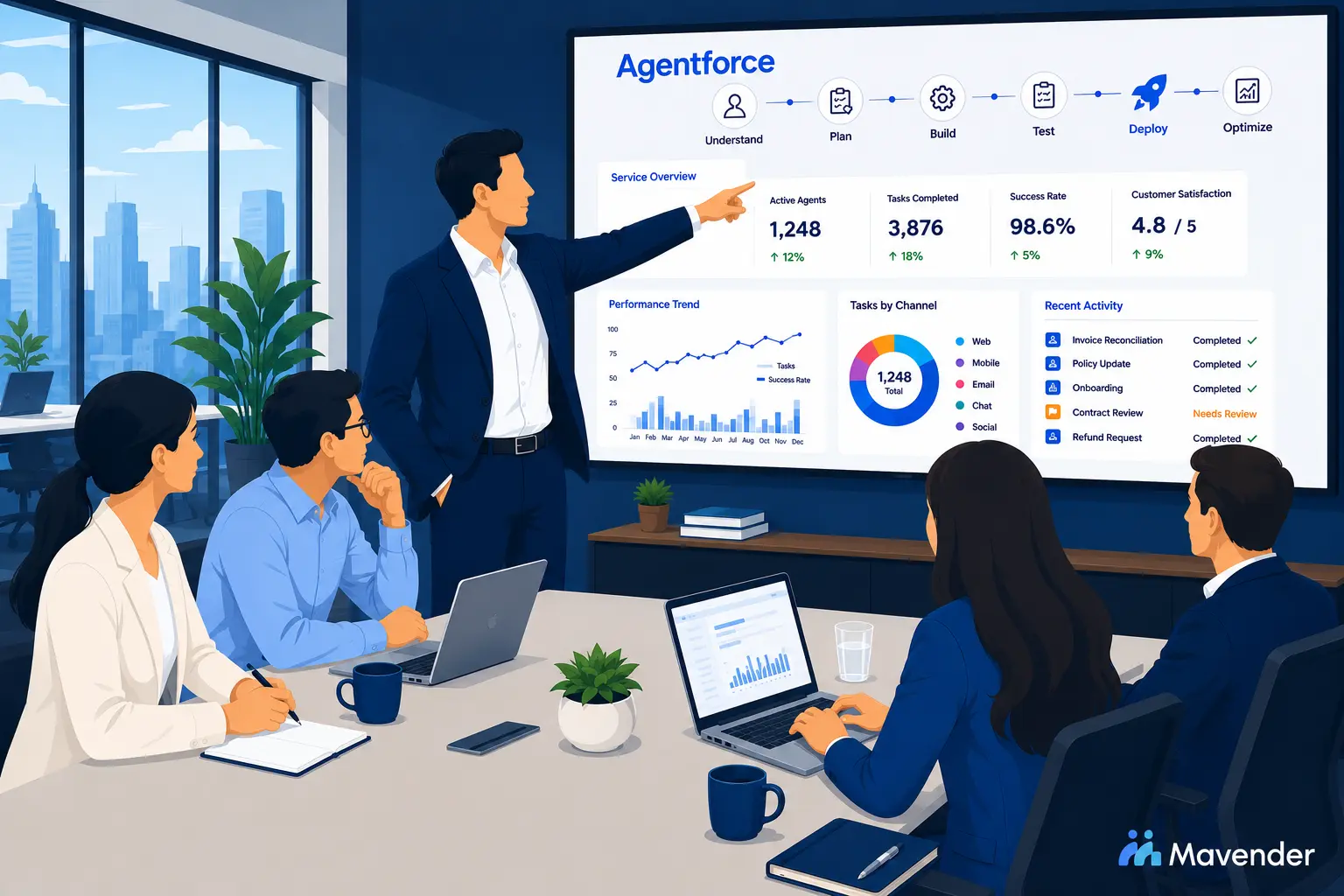
Among businesses that adopted AI agents early, the number of agents created and deployed grew by 119% in the first half of 2025, and the average number of customer service conversations led by an agent grew 22 times over the same period. That is Salesforce’s own production usage data from its Agentic Enterprise Index, not a forecast.
Salesforce Agentforce, the company’s platform for building and deploying autonomous AI agents, has moved from conference demo to production infrastructure in under two years. And in April 2026 it moved again: out of the front office and into the operational core of the business.
This guide explains what Agentforce now does, where it is genuinely changing how businesses operate, why a large share of agent projects will still fail, and how to approach adoption with a clear head.
119%growth in agents created and deployed, H1 2025
22×growth in agent-led customer service conversations
94%of consumers chose to interact with AI agents when offered
In this guide
What Salesforce Agentforce actually does
Agentforce is a suite of autonomous AI agents, plus the tools to build and customise them, designed to execute specialised tasks across service, sales, marketing, commerce, and more. The distinction from a chatbot matters. A chatbot answers questions. An agent plans and completes multi-step work.
At the centre sits the Atlas Reasoning Engine. It interprets the user’s intent and the scope of the problem, decides what data is needed and which actions are required, then executes those actions autonomously to complete the task. Agents can also act proactively: a case status update, an inbound email, or an approaching meeting can trigger an agent without anyone typing a prompt.
The platform has matured quickly. The Agentforce 360 release introduced Agent Script, a human-readable language for defining conditional logic and deterministic controls, alongside hybrid reasoning that balances LLM flexibility with structured business rules, and expanded model choice including Google Gemini, OpenAI, and Anthropic. For a business leader, the practical translation is this: you can now define the rules, guardrails, and escalation points, and let agents work within them.
The shift into the back office
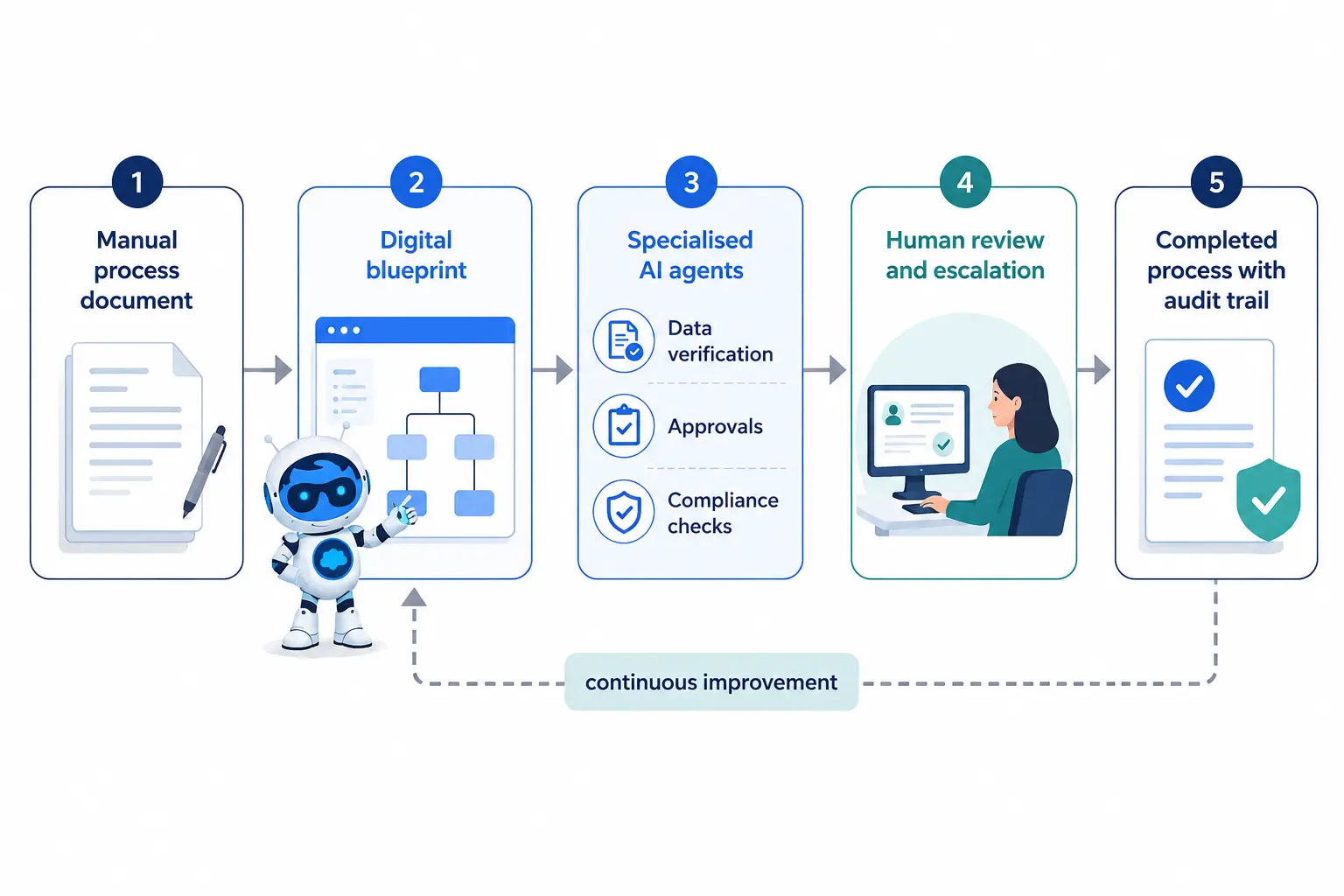
On 29 April 2026, Salesforce launched Agentforce Operations. It takes outdated, manual back-office processes and turns them into a clear set of tasks that specialised agents execute: process coordination, data verification, compliance clearance, and approval chasing. Unstructured process documents or diagrams become working digital blueprints in minutes, and more than 30 out-of-the-box blueprints cover common jobs such as invoice auditing, onboarding, and purchase order rescheduling.
The headline claims are striking. Salesforce says cycle times for processes like auditing and onboarding can drop by 50% to 70%, while manual tasks such as data entry can be reduced by up to 80%. These are vendor launch figures and should be treated as such until independently validated. The direction, however, is unmistakable.
It matters because most organisations modernised the front office first. When a fast, automated customer experience hits a slow, manual back office, the promise breaks. An order confirmed in seconds still waits days for an approval buried in someone’s inbox. Agentforce Operations targets exactly that layer. At its April 2026 launch, Salesforce said Flow integration was expected to enter beta in May, with access from Slack and Microsoft Teams to follow in June, though exact availability has shifted as the features mature.
Where AI agents are delivering results today
The Agentic Enterprise Index gives a grounded picture of where agents are actually working. Sales and service are the dominant use cases, consumer-facing industries are the first movers, and travel and hospitality saw AI and agent actions grow at an average monthly rate of 133%. Customers are not resisting: 94% of consumers chose to interact with AI agents when given the option. Nor are employees: employee interaction with agents grew at an average monthly rate of 65% in the first half of 2025.
| Business function | Typical agent work | What the data shows |
|---|---|---|
| Customer service | First contact, common queries, intelligent routing | Agent-led service conversations grew 22x in H1 2025 |
| Sales | Drafting and sending emails, creating to-dos, sending meeting requests | The most common agent actions in sales deployments |
| Back-office operations | Invoice auditing, onboarding, approvals, compliance checks | 30+ prebuilt blueprints in Agentforce Operations |
| Employee support | Internal answers, task automation | 65% average monthly growth in employee-agent interactions |
The numbers the hype ignores
A strategic guide that only quotes growth figures would be doing you a disservice. Gartner predicted in June 2025 that over 40% of agentic AI projects will be cancelled by the end of 2027, due to escalating costs, unclear business value, or inadequate risk controls. The firm also warns of widespread “agent washing”, estimating that only about 130 of the thousands of self-described agentic AI vendors offer genuinely agentic capabilities.
Yet the same analysts are not bearish on the category. Gartner predicts at least 15% of day-to-day work decisions will be made autonomously through agentic AI by 2028, and that 33% of enterprise software applications will include agentic AI by 2028, up from less than 1% in 2024.
Read those two findings together and the conclusion is clear. The technology is real. The failure mode is organisational: unclear ROI, poor process selection, and missing governance kill agent projects, not model capability.
What changes inside your operating model
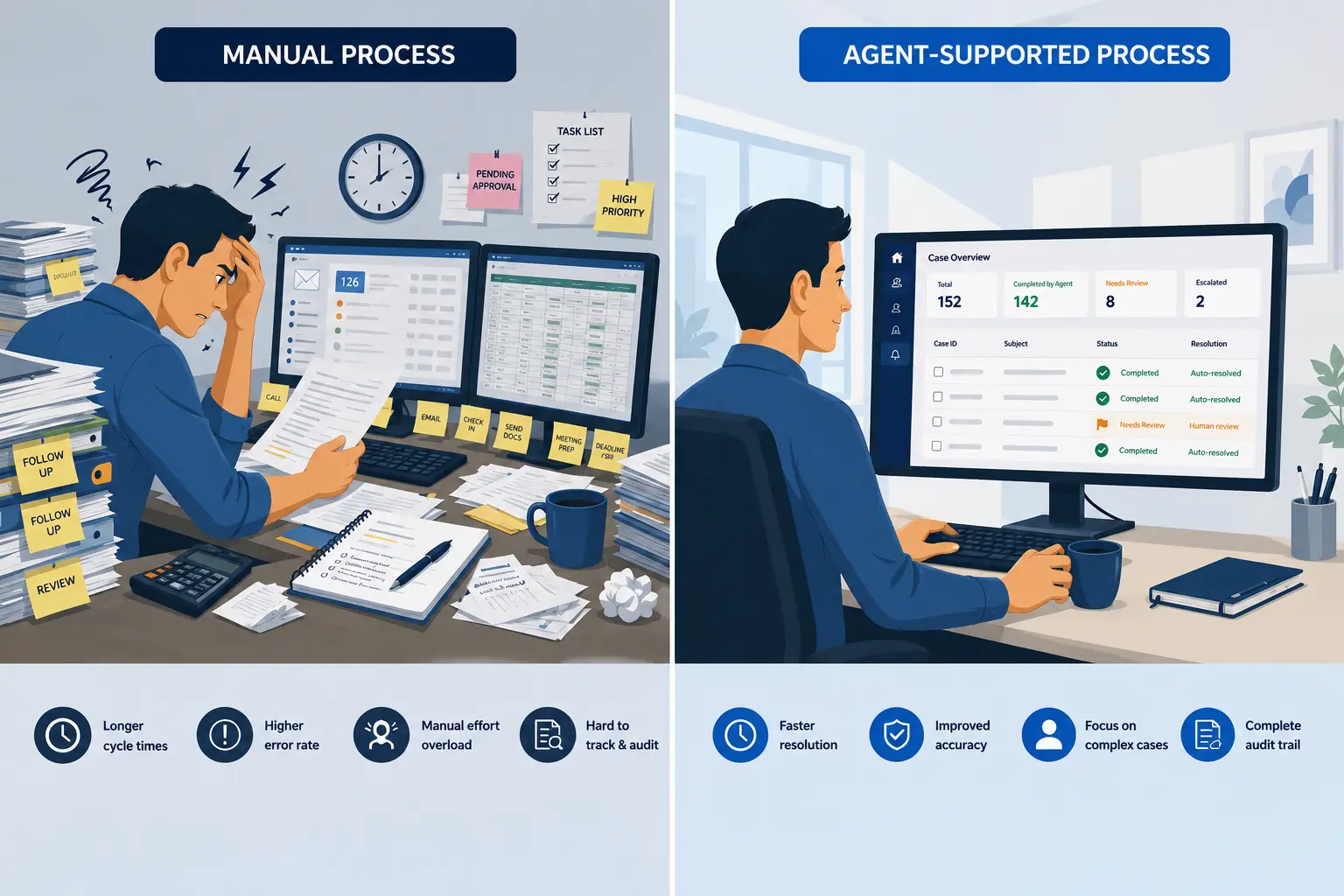
The most useful way to think about agents is work redistribution, not headcount replacement. Salesforce’s own data supports this: escalations from agents to humans increased from 22% in Q1 2025 to 32% in Q2 2025 as agents got better at pinpointing when a human was needed and routing customers to the right experts. That sounds counterintuitive. It is actually the sign of a healthy deployment: routine work resolves automatically, and complex work reaches a skilled person faster.
When routine work takes care of itself, people are free to spend their time where it matters most.
Three operational consequences follow. Process documentation becomes a strategic asset, because a blueprint is only as good as the process knowledge behind it. Data quality becomes an operational dependency rather than a hygiene project, because an agent grounded in bad data simply automates errors at speed. And governance moves from an IT concern to a board-level one, because agents act, and actions carry audit and compliance weight.
Across the implementations we support at Mavender, the strongest predictor of success is rarely the technology choice. It is whether the organisation’s data and processes are in a fit state for an agent to act on them safely.
How to approach Agentforce adoption
Start with the process, not the agent
Pick one measurable, high-friction workflow. Salesforce’s own guidance is to start small with a specific, impactful use case that can demonstrate a quick return on investment, then use that pilot to build momentum and insight. Resist the enterprise-wide launch.
Fix the data foundation first
The quality of an agent’s output is directly tied to the quality of the data it can access, which is why a unified, trusted data foundation matters before deployment, not after. If your CRM data would embarrass you in a board pack, it will embarrass you faster through an agent.
Design governance before deployment
Decide what agents can access, which actions require human approval, and how every action is logged. The Gartner cancellation drivers (cost, value, risk controls) are all governance failures in disguise. Agentforce’s observability tooling and audit trails only help if someone owns them.
Measure business outcomes, not activity
Cycle time, resolution rate, and cost per case are metrics a CFO respects. “Number of agents deployed” is not. Define the success measure before the first agent goes live, and review it against a human baseline.
Key takeaway
Agent readiness is 20% platform and 80% process, data, and governance. The organisations that win over the next 18 months will be the ones that did the unglamorous readiness work first.
Frequently asked questions
What is Salesforce Agentforce?
Agentforce is Salesforce's platform for building and running autonomous AI agents. These agents interpret a goal, plan the steps, retrieve trusted business data, and take action within defined guardrails. It spans customer service, sales, marketing, and, since April 2026, back-office operations through Agentforce Operations.
How is Agentforce different from a chatbot?
A chatbot responds to questions with scripted or generated answers. An Agentforce agent completes multi-step work: it reasons through a task, queries data, takes actions such as updating records or routing approvals, and escalates to a human when a task exceeds its guardrails.
What is Agentforce Operations?
Launched in April 2026, Agentforce Operations applies AI agents to manual back-office processes such as invoice auditing, onboarding, and approvals. It converts process documents into digital blueprints that agents execute, with audit trails throughout, and includes more than 30 prebuilt blueprints for common workflows.
Will AI agents replace my employees?
The evidence points to redistribution rather than replacement. Salesforce's usage data shows escalations to humans actually rose as deployments matured, because agents got better at routing complex work to people. Routine tasks resolve automatically; skilled staff spend more time on judgement-heavy work.
What should our first Agentforce project look like?
Narrow, measurable, and high-friction. A single service workflow or one back-office process with a clear baseline works well. Prove value against defined metrics, learn how governance and escalation behave in practice, and expand from evidence rather than ambition.
Is Agentforce suitable for regulated industries?
Agentforce Operations is generally available across industries rather than restricted to particular verticals. Salesforce's own launch examples do include regulated work: loan underwriting, where agents extract data from tax returns and validate details against compliance rules, and insurance claims intake and validation. Oversight is built in through audit trails, with every agent action recorded and mapped back to its process blueprint. The platform supplies mechanisms, though, not policy. Regulated organisations still need to define their own approval gates, access controls, and review cadence before anything goes live.
The real question has changed
Two years ago the strategic question was whether AI agents were credible. The usage data has settled that. The question now is which of your processes should run agentically first, and whether your data, processes, and governance are ready to support that safely.
Our view: over the next 18 months, the gap between organisations will not be defined by who bought agent licences. It will be defined by who did the unglamorous readiness work. The 40% of projects Gartner expects to fail will mostly belong to organisations that skipped it.
Need help assessing the right Salesforce approach for your organisation? Connect with our consultants for practical guidance tailored to your business needs.


Comments
adamgordon
Thanks for sharing this post, it’s really helpful for me.
cmsmasters
Glad to be of service.
annabrown
This is awesome!!
cmsmasters
Thanks.
Haseena Kamarudeen
Test